Showing posts with label Shane de Lange. Show all posts

THE SAME SUBJECT CONTINUED [AFTER HUME]:


“The name is the end of discourse.” 

                                                                    - Michel Foucault.

What is in a name, other than signifying cancellation? Asha Zero’s paintings are testaments to this question. Even if read as a name, Zero as a moniker would nonetheless signify a vacuum, an indecipherable title with no discernable gender, politics, ethnicity, or socio-economic standing. Much like a brand, Zero interrogates the anonymity of the subject, the value of deception, where information is ubiquitous, and schizophrenia combines with anxiety to construct a benchmark for the here and now. From this basis, Zero appropriates from the media, creating trompe l’oeil painted surfaces that not only resemble collage, but also resign to the conceptual underpinnings of collage. By confronting painting under the rubric of collage, Zero embraces erasure, interference and artifice as the ‘norm’; an indifference-in-difference prompted by Marcel Duchamp, subverted with tremors of Andy Warhol, echoing Richard Hamilton.

Paying homage to the tradition of collage set forth by inter-world-war protagonists such as Kurt Schwitters, Hana Höch, John Heartfleld, Raoul Hausmann, Aleksandr Rodchenko, and Gustav Klutsis to ‘name’ a few, Zero steals once mediated imagery, now weathered and torn, discarded, annotated with graffiti and a plethora of other graphic elements. These sources are all forms of mass communication that once used to conceal yet now somehow reveal. Zero’s voice is a palimpsest, the only way to arrive at something relevant is to combine elements together, to somehow recreate or simulate the notion of ‘otherness’.  Apathy being an agent of the ‘norm’, its symptom being the loss of difference, Zero’s cut-up images are a sign of the times, products of the system, conveying a message of Zeitgeist in Babel. It is within this post-global village landscape where Zero’s portraits declare the status quo staggering upon a bricolage. Zero’s paintings contribute more than just the sum of all parts, unfixing signifiers, stirring up turbulence, all developed from over-communication and an addiction to the media. There is no turning back, only surrender.

"It is only through difference that progress has been made. What threatens us right now is probably what we may call over-communication – that is, the tendency to know exactly in one point of the world what is going on in all other parts of the world. In order for a culture to be really itself and to produce something, the culture and its members must be convinced of their originality […] We are now threatened with the prospect of our being only consumers, able to consume anything from any point in the world and from every culture, but of losing all originality."

                                             - Levi-Strauss.

Zero draws from the conventions of the avant-garde, and the ongoing movements of the underground, including Dada, Punk, and current Street Art and Lowbrow trends. With the world in a state of Information overload, supporting a materialist existence that continually references itself, feeding off of itself, subconsciously inviting one to consume ever more to the point of critical mass and terminal identity, Zero exposes a sales agenda so pervasive that it almost does not need the consumer anymore.


Ideas being objects, with advertising, branding, and corporate intentions signifying the contemporary ideological canon, Zero juxtaposes and superimposes surfaces, concepts, and other communications, treating them in the same manner as objet trouvé, reverse-engineering commonplace broadcasts and points of contact, such as advertisements, magazine spreads, headlines, signs, billboards, posters, album covers, fashion photography and the like. From this archaeological perspective, the numerical digit Zero once again becomes a suitable replacement for the artists name, developing into a mechanism; a cut-up identity, constructing paintings that immediately communicate the primary concerns of collage: intertextuality, appropriation, pastiche, superimposition and juxtaposition.

‘We’ are the subjects of Zero’s portraits, Burroughsian cut-ups – disposable, interchangeable, random, yet somehow structured, serial, and patterned. Where humans once consumed media, it now consumes ‘us’. Zeroed-in, Zero’s work tolerates the extraction of small amounts of barely intelligible bits of information. This information is omnipresent across the painted acrylic surface, but has lost practically all its agency, meaning, and path of ‘origin’. Yet, despite being bereft of a suitable history, Zero’s cut-up images say something powerful about the murky opposition between historicism and futurism:

“When you cut into the present the future leaks out.” 

                                                                                       – Burroughs.

In this sense, Zero’s paintings take advantage of the value-of-deception inherent to popular culture and the mass media, sampling glitches and iterations from mediocrity, re-remixing scraps that have already been Xeroxed, copied, or stolen. Rendering the here and now in bits and pieces, hyphens and splices, Zero’s paintings dictate impossible exchanges through the continuous, looping sedimentation and erosion of information, in-turn generating new, hybridized and mutated forms of meaning. Furthermore, Zero ‘hacks’ the familiar, the commonplace, evading efforts to decipher or extract any fundamental or conclusive meaning.

The world is no longer binary; it isn’t root-like with hierarchies and oppositions. It is now anarchic, a rhizome, where the subject, the self, the one, or whatever analogy there may be becomes an indecipherable cipher within a hum of cellular automata. In a world that has lost all sense of the real, Zero’s paintings numb as much as they stimulate. Paintings become topologies that have been scratched and scrambled, simultaneously multiple and singular, depicting everyman, nothingman, overman; effectively combining the ability to differ and to defer.

“Who’s the parasite and who’s the host?” 

                                                                                       – Burroughs.

_______________________________________________________________

This text was first published in the 4th issue of Kolaj Magazine, (Canada, June 2013), titled "Asha Zero: Who's the Parasite & Who's the Host - A Profile by Shane de Lange". It is the latest iteration of a series of negotiations and meditations on Zero's work from the past decade.

Copyright © Shane de Lange, 2013.

HYPHEN AND SPLICE

If hysteria was the pathology of the exasperated staging of the subject – of the theatrical and operational conversion of the body – and if paranoia was the pathology of organization – of the structuring of a rigid and jealous world – then today we have entered into a new form of schizophrenia – with the emergence of an immanent promiscuity and the perpetual interconnection of all information and communication networks.                                                          Jean Baudrillard (1988: 26)


When Picasso painted Still Life with Cane Chair in 1912 he made a profound contribution to the conversation of art that still resonates today. By combining found material and elements from the media into the painted surface, Picasso effectively breached the barrier between the real world of the viewer and the represented world of the image, heralding the emergence of Synthetic Cubism. Picasso’s hybrid of collage and painting included a clipping from a newspaper that stated “the battle has began”, knowing that the foreboding tradition of painting was under attack, and that a shift was underway in the evolution of the medium, challenging the way human beings perceive things to be, and providing a reservoir of artistic material for decades to come. Cubism incorporated the politics of the canvas, picture frame, and surrounding walls, in effect socializing painting. So too, an emphasis on the multidimensional and conceptual thinking, including the influence psychoanalysis and existentialism, altered the way we see the perceived genius of the artist, asking the question: what is in a name, other than signifying cancellation?

Asha Zero is a painter reverse-engineering these once-anarchic, now-traditional Avant-Garde ideas, hard wiring established Modernist perspectives to suite the needs of a ‘post-postmodern’ world. The numerical digit ‘Zero’ being a pertinent replacement for the authors name, Zero’s reinterpretation of identity and representation in the context of the information age finds an association with Francis Picabia’s Cacodylic Eye (1921), where the artist had his studio visitors sign a canvas on entering, not allowing for one single signature to be credited as the maker of the artwork, composed around a huge eye gazing back at the viewer. Parallel to the estrangement of the author, the use of body parts, particularly mouths and eyes, is a mechanism echoed in all Zero’s work, describing the almost prosthetic, cut and paste identities that humans adopt in contemporary society. Reminiscent of George Bataille’s theoretical method known as the Exquisite Corpse, Zero in affect creates a discursive ‘body’ for the current post-industrial information age. Similarly, in Erased De Kooning Drawing (1953) painter and collagist Robert Rauchenberg took the notion of identity, discourse and representation a step further, deleting the subject in his artistic inquiry entirely, revealing more informal considerations based on the absence and ambiguity of the author, concluding his thoughts by erasing a drawing by Willem De Kooning as an act of art in his own name, at once communicating the primary concerns of collage: intertextuality, appropriation, and juxtaposition.


Subscribing to historical collagist practices, notably the work of Dadaists such as Hana Hoch, Raoul Hausmann, and Kurt Schwitters, Zero confronts the medium of painting based on contemporary conventions such as schizophrenia, pastiche, anxiety and erasure. All under the guise(s) of imitation, artifice, and anonymity, Zero takes a cue from Marcel Duchamp’s conceptual art practices and Andy Warhol’s Pop Art wit, approaching painting on the same conceptual grounds as collage, depicting the everyday spectacle of human habituation in the urban sprawl of the modern city. Zero becomes a cipher, an indecipherable title containing no gender or name, the personification of collage: a cyborg. Borrowing from everyday media sources to construct detailed, photo-realistic compositions (trompe l’oeil), Zero presents the status quo of the Global Village as a bricolage, made-up of found objects (objet trouvé) and constructed bodies, using newspaper headlines, various street art elements, billboards, posters, album covers, fashion spreads, and print ads as pertinent social content.

Delivering layered facsimiles and masked captions from ground zero, Zero stumbles upon the defunct and deteriorated relationship between the original and the representation. Where humans once consumed media, it now consumes us, and Zero presents the remnants of this memory, pooled experiences faded and used, somehow tolerating the extraction of intelligible bits of information. Rather than being direct representations from some distant ‘original’ source or ‘authentic’ subject, Zero’s paintings are processed transcripts of lost and found representations, which have lost the agency of ‘origin’. The notions of memory and history are treated in an archaeological manner, mediated and weathered into the surfaces of the urban landscape, peeled back by Zero to reveal the remaining strata of our mediation, all too often hidden from us, or simply ignored and forgotten. “The informational function of the media today would thus be to help us forget, to serve as the very agents and mechanisms for our historical amnesia” (Jameson, 1999:20). Zero finds keepsakes from the fragmented landscape of the city – its histories and geographies incomplete – in order to piece together portraits of its cyborg citizenry, blip culture, raising relevant doubts about the Human Condition.


Saturated in the synthetic culture of the 80s, steeped in Punk and Indie Rock, Zero has a penchant for the appropriation of middle class consumer appetites. Forgetting and indoctrination being the staple of the day, the working class ideology of the Apartheid proletariat gave Zero special insights into the power of propaganda and marketing, and the social programming of the minority white population. In this sense, Zero’s paintings take advantage of the value of deception, equating perception with deception, perversion with reversion, at all times being unsympathetic towards any political agenda. Zero samples glitches and iterations from mediocrity, remixing scraps Xeroxed or stolen from popular culture, numbing as they stimulate, rendering the information age as bits and pieces, hyphens and splices, scratched and scrambled. If Pierneef were alive today, Zero’s portraits would be the landscapes he would paint.

This approach to the present day by way of the art language of the simulacrum, or of the pastiche of the stereotypical past, endows present reality and the openness of present history with the spell and distance of a glossy mirage. Yet this mesmerizing new aesthetic mode itself emerged as a elaborated symptom of the waning of our historicity, of our lived possibility of experiencing history in some active way. It cannot therefore be said to produce this strange occultation of the present by its own formal power, but rather merely to demonstrate, through these inner contradictions, the enormity of the situation in which we seem increasingly incapable of fashioning representations of our own current experience. 
                                                                                   Frederic Jameson (1993: 21)


When viewed from a distance each painting appears to be hyper-realistic visions pieced together from discarded or found media parts. When each of the many segments are appreciated for their individual surface qualities, ranging from topological interactions to hijacked typographical vectors and dirty grunge-inspired textures, they display abstract expressionist tendencies, marking a sea-change in the context of Modern painting. Simultaneously multiple and singular, Zero’s paintings dictate impossible exchanges between different surfaces in a continuous sedimentation of information.

Zero’s own ambiguous identity poses a similar question, where the authenticity of the author gives way to the representation of the brand; a sentiment relayed by Guy Debord (2004:12) when he states: “The whole life of those societies in which modern conditions of production prevail presents itself as an immense accumulation of spectacles. All that was once directly lived has become mere representation”. With this simulated sense of Self Zero plays with the unsolicited aesthetics of the street, in an overwhelming image economy, a contrived society continually referencing itself, feeding off of itself, inviting one to consume. Zero’s paintings illustrate the sales agenda of the Global Village; so pervasive that it almost does not need the consumer anymore. The world is no longer about good or bad, black or white, ones and zeros; it is no longer binary, it is anarchic based on technologies that currently dictate the resolution of reality and the ‘deresolution’ of the body. Everything is transferred and transmitted under tragicomic circumstances, making room for the entropic madness of the machine aesthetic that Futurists such as Fillippo Marinetti envisaged being the culmination of mankind.

The reason I'm painting this way is that I want to be a machine, and I feel that whatever I do and do machine-like is what I want to do... If you want to know all about Andy Warhol, just look at the surface of my paintings and films and me, there I am. There's nothing behind it. 
                                                                                                                           Andy Warhol


We are all Burroughs’ cut-ups, disposable, interchangeable, random. As passive consumers, compiled identities, and poster egos, most people are bored and nobody wants to change anything, shape it, form it, and translate it into a form of expression. It’s all about imitation, consumption and manipulation, and the only way to arrive at something relevant is to combine elements together, just as Zero does. This boredom is symptomatic of the lack of difference and Otherness in the world. Zero is the only relevant symbol, Zero’s cut-up images are a sign of the times, products of the system. Much like Gustav Courbet, Zero is a realist for the times, a traditionalist conveying the contemporary message of Zeitgeist in Babel, manifesting what it means to be human in the composite landscape of website hits and dots per inch, at all times leaving the debate open and playful.


Alongside contemporary artists such as Gajin Fujita, Takashi Murakami and Barry McGee, Zero draws attention to a society in a state of terminal identity, where the neurosis observed in the everyday becomes the norm. Marshall McLuhan referred to this neurosis as ‘narcosis’ (2001:45), which is an analogy used to describe our addiction to the media and our indifference towards it, linked to the idea that human beings and culture are paramount to a reproductive organ for the media and technology. Zero executes this narcosis through transient and ambiguous mergers of realism, naturalism and abstraction, somehow incorporating small pieces from just about every discursive structure in painting since the Renaissance. Silence and noise find common ground here, where the cosmetic fabrications of the media are expressed through hybrids of texture, colour, and pattern; chimeras that lead to continuing discussion on painting.

Micro Cluster Picnic progresses past Manichean binaries, in a post-hyperrealist realm that is inadvertent towards humanist or capitalist polemics and politics, differing from previous exhibitions, say for me (2008) and macro soda text hits (2009). As the world grows ever smaller, proximity being equal to promiscuity, Zero chooses anonymity over autonomy. Embodied and embedded, disassembled and reprogrammed, Zero’s paintings contribute more than just the sum of all parts, unfixing signifiers, stirring up turbulence, entangled in alienation and artifice to establish a clear-cut message. By piecing together counterfeit truths that can be bought over the counter, Zero makes the distinction between the authentic and inauthentic obsolete, perhaps exposing the only ‘truth’ left. History, identity, representation, culture, and the like, no longer teeter on the opposition between good and evil, or even tinker on the pitting of evil against ‘evil’, Zero simply makes such distinctions null and void.

Text Copyright © Shane de Lange 2011.
Image Copyright © Asha Zero 2011.

WRITING AND INDIFFERENCE, UPENDING THE ORDER OF OTHERNESS

"Venerated Villain (Kenosi)", 2011

If there is a constant to chaos it is dualism; where two Manichean halves clash. The vying of the irrational against the rational makes Africa the perfect breeding ground for chaos, where conflict, war, violence, and poverty in the wake of decolonization, global capitalism, and the resurgence of pre-colonial tribalism simultaneously condemn and validate oppression. It is from this ‘tragic-state-of-affairs’ that corrupt and totalitarian powers contest for ownership over a multifaceted and layered geography. Within this paradigm small pockets across Africa are attempting to find recourse towards identifying themselves, in many ways reversing the voyeuristic gaze of the West, becoming voyeurs of the West and vanguards of their own culture, in the process finding rootedness; a story of difference, and the indifference that prevails to destroy it.

Frank Marshall is a photographer who dissects the question of representation in Africa by focusing on a special outcropping of Heavy Metal subculture in Botswana. He does so from a formal photographic stance and as a sub-political statement, constructing an image of the Renegade as a pretense to the avant-garde. Heavy Metal is a divergent subculture, and its quasi-nihilist tenets seem to have developed into an uprising in Sub-Saharan Africa, provoking those myths and stereotypes that sustain the borders of supposed social order, dummy-revolutions, and apparent power struggles; all under the guise of victimhood in the shadow of the post-colony. What the so-called ‘Batswana’ Heavy Metal community is nurturing in Botswana is merely one of many encouraging microcosms of change sprouting all across Africa. The diverse manner in which this change is happening exhibits how the continent is calibrating itself to the demands of the Present and the obligations of the Past. With the Batswana, Marshall has taken it upon himself to document this process unfolding, one individual Motswana at a time (‘Motswana’ being the singular to the plural ‘Batswana’).

Bound by the Moon, 2011

Marshall tentatively situates himself as a mediator chronicling the assimilation of Heavy Metal by a group of Batswana rebels creating an emergent rootedness in a geography where tradition, politics, and tribalism create sensitive grounds for expression. These Renegades are almost thespian in their unconscious re-reading of post-colonial hauteur. This ‘performative’ aspect is a dominant theme in Marshall’s photographs; where the Machiavellian world of Heavy Metal meets the Manichean world of Colonialism, uniquely displayed in each individual Motswana portrait.

Such sub-cultural insurgences supply alternative lifestyles that veer from long-debated post-colonial concerns that either views subculture as a luxury of the First World or the corruption of the Third World. But such insurrections are anomalies attempting to deal with the challenges of Modernity, and the Batswana community does so through pure idiosyncratic rage in keeping with the idiom of Heavy Metal.


"Death", 2011

Increasingly, these subversive apolitical, non-traditional caucuses establish themselves unobstructed by the moral and political predicaments created by post-liberation, often corrupt leaderships in underdeveloped democracies. Although many subcultures exist in seemingly developed African states such as South Africa, this particular fraternity in Botswana is provoking a unique polarity-shift between the West and its perceived Other, allowing for a greater sense of belonging and fellowship amongst the Batswana Heavy Metal community, geared towards a confrontation with the persuasions and dysfunctions of Globalization and Capitalism. The Batswana take advantage of the spectacle cherished in Heavy Metal lore, parodying the larger Spectacle created by the ‘powers-that-be’, turning the notion of ‘Otherness’ on its head. The Batswana become voyeurs of the old oppressor; the West becomes the fetish, a novelty in light of the outsider status of Heavy Metal in Botswana.

Marshall’s portraits of the Batswana pose important anthropological questions about the nature of cultural effigy, specifically relating to pop culture, consumerism, and the topology of post-decolonial machinations. The stigma surrounding Marshall’s Renegades in their own local community also reveals a greater cultural chimera: they are the oppressed, steeped in the tactics of the oppressor, conveying this fact through skulls, scars, and chains that ironically put them on the fringe of their own society. Despite this, the Renegades keep with Heavy Metal’s primary archetype, envisaging a ‘new’ kind of African male: damaged yet intimidating, at the end of it all, with nothing to lose, subverting the system with his anger and indignation. 


"Morgue Boss (Rock Phex)", 2011
 
In terms of demographics, Heavy Metal has historically been associated with those of Caucasian, male, patriarchal, Christian (by proxy anti-), and Eurocentric persuasions. The dissimilarity is obvious, but the one key similarity here is that ‘Metalheads’ stem from the lower working class, giving insight into the socio-economic strata of each Motswana, whom relates to the blue-collar working-class roots of Metal, its origins in Rock and Roll during the 1950s, and its connotations to the Hell’s Angels, all working against the system to find an original identity. This influence can be traced even further back to the machismo of the Wild West era. Africa being the ‘new’ Wild West, the Renegades parade themselves in leather boots, pants and jackets, jeans, studs, and homemade belts made from bullet shells; a material articulation of rebellion to say the least.

In this way, the Batswana have annexed unclaimed cultural territory, seizing a sense of authenticity and ownership, in turn upending the order of ‘Otherness’ by ‘colonizing’ a Western subculture. In this context, visibility equals worth, where music is a material currency, and performance is an unmasking agent revealing the West as a perpetrator of inauthenticity. To ‘colonize’, based on the humanist pedestal of Greco-Roman ethics, leading into Christian moralism, Eurocentric narcissism, ending in Modernist utopianism is negated by the primal, pagan, pre-Hellenistic tribalism, tolerating the Batswana to embrace a ‘cult of Dionysius’ as it were; representing the marginal folklore of Heavy Metal regardless of ethnicity, simply because it speaks the language of tragedy. 

"Dead Demon Rider I", 2011

Tragedy is an intrinsic art form based on human suffering, offering pleasure to its spectators. While most cultures have developed forms that provoke this paradoxical response, tragedy refers mainly to the Ancient Greek dramatic traditions that play a pivotal role in the determinism of Western civilization, and by proxy Colonialism. Marshall accentuates this sense of tragedy by acquiring theatrical elements through Spectacle, temporality, and iconicity, illustrating the evolutionary strides in the post-colonial mindset from rebels, to revolutionaries, to Renegades. In this way, Marshall actively mythologizes the Batswana, teetering on the fringe of fantasy and reality, bearing witness to the manner in which Heavy Metal is adopted and adapted in Botswana.

The historical significance of Marshall’s portraits is further emphasized by formal considerations of tone, color, and one-point perspective, using ambient picture planes, differentiated focusing and a distorted depth of field. His formal engagement with the street, and the African urban environment in particular, turns his portraits of Motswana individuals into ‘visions’, achieving a vivid painterly effect outside the confines of the artist’s studio. In this light, it seems ironic that Marshall’s cult-like visions can only be accessed through the tragic social rites of the gallery, occultist in its purist form. Marshall’s photographs are vocal about depicting a community marginalized by society, blurring the boundaries between liberty and fraternity. Marshall’s Renegade’s have found a semblance of an answer by co-opting Heavy Metal, finding a substitute for the lack of answers produced by the Post-colonial enquiry, permitting them to embrace anything that popular culture finds unacceptable, proving the manner in which Africa is calibrating itself to an increasingly homogenized world. 

"Loyal to None", 2011

Text Copyright © Shane de Lange 2011. 
 
Image Copyright © Frank Marshall 2011.


GHOSTLY DEMARCATIONS

Based in Cape Town, and represented by the SMAC gallery in Stellenbosch, Anton Karstel’s work tinkers with the perceived loyalties and presumed modalities that are strewn over the scarred socio-political landscape of South Africa. From this foundation, Karstel deals with the idea of the ‘post-‘, ghostly in his conceptual approach to historical conventions and cultural dictates, always throwing curveballs at the establishment, leaving one wondering where his loyalties lie.

As an acknowledged conceptual artist, it seems ironic that Karstel’s most recognized works are oil paintings, a traditional medium proclaimed by the vanguard to be at a critical dead-end. However, his use of painting seems apt in the context of South Africa’s art market and political scene, where many artists and galleries resort to cheap conceptual tricks in order to make a quick buck, not realizing that the consumables they create for the market are tantamount to delinquency, with the system being a form of exploitation. In keeping with the tradition of painting and the legacy it holds, Karstel builds an argument about the value of art and measure of value. Instead of falling-back on over-used gimmicks and derivatives that dominate the market today, Karstel’s subject matter is relevant and profound, manifesting meaning in much the same manner as memories are distilled in old deteriorated black and white photographs and films.


Karstel is given allowance for using the institution of oil painting on conceptual grounds, granting him access to memories that would not usually be accessible to any white male stemming from an Afrikaner heritage. He excavates the archaeology of South African tradition and transition, skillfully portraying South Africa’s often shadowy, disturbing and corrupt, historical currencies, exposing the specter of ideological and political abuse that still affects us today. Karstel performs an autopsy on South African history, constructing a site, or body that is still being navigated and negotiated. His portraits and cityscapes offer us a grotesque and alienating reminder of the all too common ritual of history repeating itself, parading as nostalgia, recalling the photographic productions of Christian Boltansky and Alfred Stieglitz.

Karstel’s paintings are physical, punching through the formal and theoretical facades of the materials he uses, based on the fact that it is ‘historically justified’ to do so, rendering the surface of the canvas a territory to be disputed. He interrogates the supposed ‘autonomy’ of the illusory picture plane, making the assumed homogeny of his subject matter apparent. This is evident in his Prime Minister series, where he renders the past leaders of the Apartheid era as eerie, almost monstrous, deteriorating apparitions.


By allowing his audience to contemplate this body, Karstel makes a point not to obliquely reference history, rather seeing it as organic and fluid, challenging the integrity of the original image and its related ideology. What was once equated with truth and power is now understood to be momentary and abstract. Ghosts abound, from Claude Monet to F.W. de Klerk, Karstel pieces together fragments of a not so wholesome colonial past that is perversely ever-present and extramundane today. He appropriates from these archived spirits their signatures, in so doing transforming his paintings into historically embodied ‘readymades’, found objects that effectively declare the impact that painting can still achieve.


Karstel’s tactile impasto paintings are both incorporeal and corporeal, his subject matter being ubiquitously present and absent in their plasticity, where appearances are certainly deceiving, evidenced by his Beach Girls series. By focusing on ideological signifiers, such as architecture, leaders, and objectified women, the fleeting and the fleeing are poeticized through his ethereal ala-prima technique, finding uncanny compromises between the past and the present through the ‘stickiness’ of the politically and historically unmentionable. One may say that this is an indictment of the represented and the repressed.


Karstel discloses the relations between mortality and morality, history and memory, thereby examining the mechanisms that construct our current sense of guilt, tolerance, anxiety and fear. The corroded hegemonies in his cool, saturated, low-key paintings sheds light on the ideological processes and power structures that make us believe what is ‘acceptable’ and ignore that which is ‘hidden’. In so doing, Karstel’s paintings, confiscated from socio-cultural burden’s and historical limitations, make departures from what has normally been regarded as either inside or outside, constantly leaving question marks where answers were once thought to exist.


Copyright © Shane de Lange 2010.

TRADITION AND TRANSITION


It was September, late in the evening, and copious amounts of Shiraz and Merlot had led Kevin Roberts and I to leave the comfort of our loaded conversation, outside, around a warm fire. In our heightened state of awareness we decided to childishly wander off into the cold, dark bushveld on the outskirts of a hamlet called Rosendal near the border of Lesotho and the Orange Free State. Our task was to reach a distant red light, which looked to be some kind of aircraft beacon on top of a hill on the other side of a large open grazing field. As we walked I realized the fascination that often strikes me when I leave the city and enter the countryside, where it seems plausible just to forget everything and get lost in the vastness of the landscape; disappear, never to be heard from again. At the same time, one also feels an odd connection to the surroundings by virtue of one’s disconnection from nature and dependence on the supposed sanctities of the city. As we haphazardly stumbled across the uneven, cattle trodden ground an unlikely sense of awe entered my mind, knowing that we were about fifty kilometers away from the nearest town. Of course, despite the effect of the red wine, reason interjected and I soon dispelled my overtly sentimental ideals, falling back into the narcissism of human reason.
Perhaps it was our scholarly ramblings, which certainly generated some relevant discourse, or maybe it was the resonating image in my mind of Kevin’s painting on the wall back at the house, but I came to realize that the integrity of his subject matter is oddly reminiscent of the area that we navigated that night in the highlands of the Basotho people. The silhouettes of the sandstone cliffs, moonlit thorn bushes, and wind swept grasslands in the distance created an undeniably South African vernacular image in my mind that had an uncanny resemblance to the images in Kevin’s artworks. His idiom is interwoven with rich visual tapestries that seem tailored to the farmlands of the Eastern Free State where we found ourselves exploring that night. The indigenous colors, cognizant gestures, and considered textures of Kevin’s compositions are stitched and cross-hatched onto traditional themes such as portraiture, still-life, and landscape painting to reveal the underlying poetry that is diversely South African. Although much of the imagery in Kevin’s work is painted from memory, this geography in the Eastern Free State, with its cattle, corrugated iron roofs, grasslands, dams and irrigation, could be serialized as the inspiration for his paintings.
Local crafts such as weaving, braiding, and pattern painting seem to be dominant techniques that Kevin uses to customize the topography of his works. He unconsciously mediates the patterns of the land with the crafts of the people inhabiting it. Although Kevin does not directly comment on the socio-political issues at hand, he does appropriate certain activities and trends in order to cut and paste his mythology together. Teaming fish, chopped and gathered twigs, ploughed fields and sown crops may suggest some sort of commentary on the economic structure of this country, and many of these analogies were commonplace in that area of our boisterous voyage. More so, these icons represent the life sustaining flora and fauna of the land, canons to the labored over soil. This approach is also symbolized by Kevin’s use of fishnets, reservoirs and various environmental measuring tools, which reminded me that despite the isolated position the presence of man was undeniable, evidenced by the glowing red beacon that Kevin and I were traveling towards.
As we walked we discussed Kevin’s design motifs and how he fuses the naturalism of his subject matter with the abstraction of his metaphors to create a serialized and patterned realism. This vernacular is continued in his use of wooden parquet flooring and lattice screens, netting, doilies and lacey algorithms, which he superimposes and juxtaposes with flat or textured surfaces, thereby toying with the perception of realism, naturalism, and abstraction. The landscape itself becomes a lattice of meaning and signification, a matrix of symbols and archetypes born from human systems of categorization and organization (taxonomy and teleology). Cattle tags and plant tags, along with various other labels also suggest the historicism and materialism of the world that became obvious to me that night. Kevin did not seem too concerned with my embellished commentary of his work, making me come to the conclusion that he was somehow ulterior to the petty proclamations of the postmodern meta-narrative, comparable to the attitude that Jean Dubuffet had towards the foundations of art, or Michel Foucault had towards the structures of society.
By the time that Kevin and I had reached the end of the field, which was bordered by a barbed wire fence, forbidding us from reaching our target, he briefly described the infrastructure of the surrounding farms. Despite the intrusive economic necessity of human development, the rawness of the territory was still apparent to me. After taking some night pictures of the distant Maluti Mountains we began to make our way back to the house and the thought of a warm fire became quite a source of comfort to me. We went on to discuss this ulterior nature of his work, being neither traditionalist nor conceptualist, or overtly theoretical. His formal stance can be compared to that of a Renaissance master, but he clearly plays with institutional limitations and reconstructs traditions using rehashed modernist notions, such as deconstruction, fragmentation, and repetition. This is coupled with a random, almost contradictory knowledge of critical theory and philosophy, using notable archetypes such as the Jungian, dualistic analysis of anima and animus, which would certainly explain Kevin’s use of various, similar looking women in his work and his placement of texts such as the Feminine Mystique by Betty Friedan in some of his paintings.
If one had to theorize about Kevin’s work then I suppose that, much like de Chirico or Magriite, his act of completion is established on the primacy of his environment, focused on the brutality the individual subconscious and the ubiquity of the collective unconscious. Kevin’s various overlaid, superimposed, saturated, multiplied, juxtaposed, and repeated metaphors, signs, symbols, patterns, texts, and naturalistic, illusory elements structure a humble iconography that embraces the ‘outsider’ traits of naivety, innocence, and primitiveness. He executes this iconography with the utmost level of skill and intelligence, creating a silent discourse around territories, universals, absolutes, and borders. His work is almost anarchic in its subtlety, abstract in its realism, tentatively and sensitively suggesting memory and history, diversity and difference, passage and time, containment and freedom, nature and culture.
As we got back we doused the fireplace outside, picked up the empty wine bottles and entered the house. Kevin started the fireplace inside and put some coffee on the boil. I began to conclude my thoughts, devising odd couplings in my head, such as idiosyncratic multiplicity. The final thought was that Kevin makes art that is neither postmodernist nor modernist; his approach can be described as non-conformist to such conditions. The didactic and cultural nature of his work always keeps the door open to debate, but he does not consciously make art to fit within the contemporary regime of South African art, and the often paradoxical character of his work surprises even the most conceptual sensibility.

4'33" (FOR DIGITAL MEDIA)


The thought crossed my mind a few weeks ago to do a performance of 4'33" using digital technology, modern sound equipment, and music production software. A recent event focusing on performance art at the Bag Factory, called RE/Action, gave me the opportunity to take advantage of this happy idea.

4′33″ is an experimental musical work by former Fluxus member and avant-garde composer John Cage (1912 - 1992). The original piece was composed for piano and consists of about four and a half minutes of silence with an introduction by Cage saying: “I have nothing to say, and I am saying it”. Even though its first manifestation was for piano, Cage had originally composed 4’33” for any instrument, giving me allowance to perform a digital version in two parts in front of an audience at the Bag Factory in Johannesburg.

Cage structured 4’33” in three randomly selected movements, depending on the action, performer, and setting. Thus, the beginning an end of each movement is not dictated by the composer. Despite this premise, I decided to compose the digital version in two parts, the first part being the original piece, and the second part taking the form of a remix. Cage did, however, stipulate that the title should reflect the timings for each movement, which is why my performance of 4’33” began at about 19:15 (after all the other performers at the event had finished). Unknown to me this was also about the time that the Imam calls the faithful into prayer at the nearby mosque. The original sub-title of 4’33” was “A Silent Prayer”, which was referred to by the presence of Lerato Shadi, suspended with cloth in a messianic pose on the wall opposite to me, giving the entire room a religious atmosphere of Christian and Muslim, East and West undertones (or overtones; whatever strikes your fancy).


I introduced myself and the piece, and then I sat down in front of my Korg midi controller, MacBook Pro, Tascam audio controller, a marantz amplifier and Sony earphones; surrounded by condenser microphones, KEF monitors, lots of cords and about thirty five people. I readied myself, because in my experience sound equipment almost always has issues, not to mention computers. Each part lasted about 5 minutes, including the breaks between movements and live editing time. As mentioned, the first part consisted of Cage’s original 4’33”, with completely random beginning and ending points for each movement, and 30 second intervals separating the three movements. I thought part one was fairly successful because most people kept as silent as they could, except for some late comers who did not quite catch on to what was going on, but the Imam's sound came totally unexpectedly, and almost perfectly.

After the piece had been successfully recorded in part one of the rendition, there was about a two minute respite before the commencement of part two. The chants of the Imam took up most of movement one in part one, so I decided to focus on that section of ambiance in the remix. I aimed the microphones at the monitors and left them to record whilst the remix was played through the speakers. In this way the remix was recorded as heard by the audience during its live production. Silence and noise was amplified, spliced and fragmented in a totally random manner, bearing no pattern except for some repetitive sections, with no interludes or pauses for about four and a half minutes. Part two was interesting because onlookers did not know they were still being recorded and felt free to speak there minds. Little did they know that I could hear their conversations very clearly with my earphones, with statements like: “what is he doing… Why is he just sitting there?”, and “is there a problem with his equipment?”


Once both parts had been completed, after about 10 minutes, the recording, re-recording, and remix was published immediately on an Ipod Shuffle and put up for sale for R2000. There was no buyer, which completely dumbfounded me, because I was sure that people would give anything for an Ipod shuffle with amplified, broken silence on it. Given this disappointment an edited and mastered version of the two parts will also be made available as a free download in due course.

The full title of this rendition has been settled on as: 4'33" (a silent prayer for Darfur), piece for digital media. This title was influenced by the serendipitous event of the Imam chanting, and also by a friend who answered me when I told him about my performance: "...fuck Shane, why do you perform these meaningless acts when you could be saving people in Darfur or something..."

Thank you to Johan Thom for organizing the event, "RE/Action". Thank you also to all the other performers, Rat Western, Lerato Shadi, Bronwyn Lace and all the rest, you guys were great. And, thank you to the Bag Factory for hosting the event.

Below is a nice rendition of 4'33" by David Tudor, a student and colleague of John Cage.


THE ANTICUBE MANIFESTO


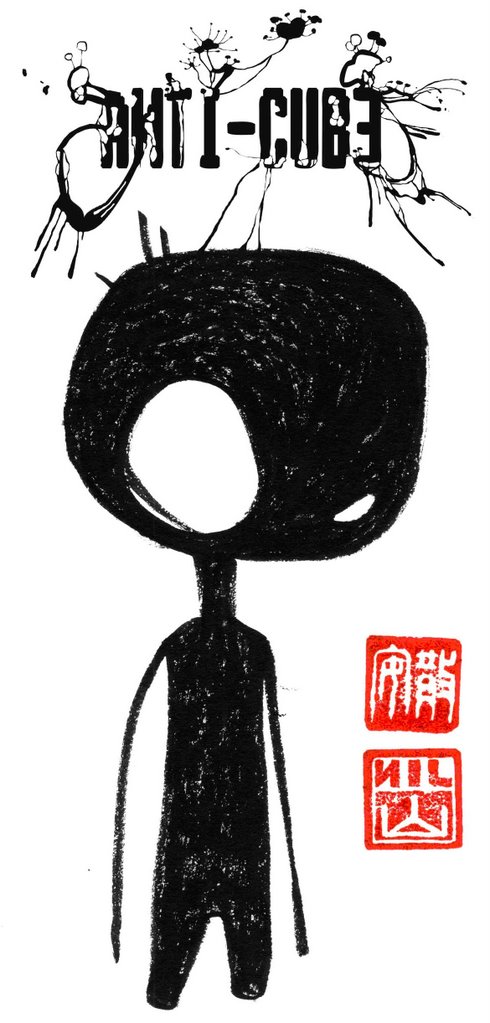
Anticube is an idea that views the cube as the symbol of humanism and the west. The cube can be seen as a signifier for notions such as idealism, logic, rationalism, progress, homogenisation, globalisation, and most importantly, humanism. Anticube situates the traditional, typically modernist, art gallery as a concept and a space that epitomises the totalitarian worldview that has evolved from humanism. It does so by emphasising the context of an exhibition-as-happening; an abstract construct in a solid architectural space. Art can also be viewed as one of the key humanistic disciplines. Anticube is an attempt to deconstruct the white voided cube of the gallery, specifically in relation to the artworks that give it purpose, and are, in turn, given value through the gallery. The gallery is the centrepiece of the exhibition; a kind of factory for meaning and value. The gallery is a cathedral to humanism. Anticube achieves this message by using and appropriating institutionalised and established styles, drawing inspiration from a variety of interweaving sources, and often opposing disciplines, specifically modernist movements such as Dada, De Stijl, Abstract Expressionism, and Minimalism, juxtaposed with postmodern trends such as Art Brut, Neo-expressionism, and graffiti. Modernism can be viewed as an era where humanism reached its pinnacle, and where the concept of the ‘human’ and ‘mankind’ reached its final narcissistic development.

The cube is the embodiment of functionalism and formalism; the symbol of modernism evident in the works of such modernist artists as Ad Reinhardt, Barnett Newman, Sol Lewitt, Kurt Schwitters (Merzbau), Piet Mondrian, M.C. Escher, Donald Judd, Franz Kline, Cy Twombly, and Josef Albers to name a few, all of whom have influenced the concept of Anticube. Anticube dissects the assent and dissent of humanism, particularly in relation to western societies death drive for power, knowledge, truth, and the abstract, evident in the modernist belief in progress, formalism, and functionalism. In this way, Anticube tweaks modernist perspectives to encompass the entire gallery space. Instead of being limited to the dimensions of the frame or the picture plane, the gallery is incorporated into the artwork, as the artwork, where it can be said to implode on itself. The beginnings of an interplay between inside and outside (inclusive and exclusive) begin here, where the modus operandi of Anticube can be established; that is, as a deconstructive operation that dissects and infects, injects and ingests, regurgitates and emancipates the picture plane by emphasising the hyperbolic issues surrounding such mechanisms of supplementation as ‘beyond’, ‘post’, ‘new’, ‘now’, and ‘then’.

There is nothing new, subversive, or original about Anticube, and it announces this fact. Anticube is aware of its dependency on the modernist anatomy that it is trying to subvert; a schizophrenic resolution at best. Anticube attests to a space that exists in the ashes of human moralism, in the aftermath of utopian entropy, where good and evil are petty and archaic archetypes, and evil is pitted against evil, making dualisms and boundaries obscure and irregular. Anticube’s ethos can be described as “Nilfunct” (nihilism, non-function), where the distinction between prophylaxis and virulence fades away and the indifference towards the other becomes acute. Anticube is both a postmodern criticism and homage to modernism. This schizophrenic embrace is a pastiche of orderliness, of structure and fragmentation, of pattern and randomness, which can only be described as posthuman.

By placing these ideas in the context of the gallery, Anticube stresses the incestuousness of the grid and the promiscuity of the cube, which can be seen as an analogy to the virulence of the global village and information based society. Anticube is also a reaction towards present communicative trends in street art and new media. It is an amalgamation of various disciplines comprising the so called fine arts, graphic and interior design, illustration, graffiti, and new media to name a few. This is a perspective that tries to expose the voyeuristic and panoptical intensity of western ways of seeing that tends to boxed-in and put things in their place; where boundaries are constructed, lines are drawn, and dualisms and hierarchies are created. Anticube expresses the cube as an attitude of bleached out indifference, a moratorium of the present that illustrates the limbo of postmodern living, waiting for the arrival of the posthuman. New technologies are only accelerating the human drive to extinction, and Anticube exploits such extentions.

Anticube is a paradoxical attempt to bring into context the whole ‘idea-of-art’: a discipline that has documented the history, ideology, domination, and narcissism of ‘mankind’ and humanism. Anticube celebrates and mourns the culmination of humanism in modernism. The artworks that are exhibited in Anticube, which comprise of drawings, paintings, and animations, play a pivotal role as constructs in this meta-narrative of humanism that is monumentalised in the form of the gallery (the cube). Anticube breaks-down the architecture of the cube, and it is itself a deconstructed cosmology that is very much under construction. Anticube is inseparable from the cube because of its opposition to it. This is why Anticube can be said to tell a story of dualism, revealing a mythology based, media orientated, technological world of instant access and communication. It reveals the anatomy of communication and the consequences of gaining access to the cube. This alters the notion of universalism in a western sense, exposing it as just another form of imperialism. In a traditional sense, to be human is to wear a mask. Being branded human is the process of the cube. Everything that can be understood as traditionally ‘human’, such as Christian moralism, heterosexual establishments, and patriarchal institutions, are at an end. Many of the conceptual drawings in Anticube attest to this idea, and the geometric abstractions of the paintings literally apply this posthuman perspective to the cube. Anticube suggests the posthuman notion, stemming from postmodern discourses such as feminism and post-colonialism, that the ‘now’ is a situation of ‘nihilation’, and the ‘new’ is a premise for annihilation through the indifference of the ‘human gaze’. In Anticube the only question that matters is whether to choose the path of ‘nihilation’ or annihilation in lieu of the universalism and hegemony of the west, modernism, and humanism.

Following from this perspective Anticube rekindles the already mundane ‘anti-art’ scepticism towards the art market, specifically in relation to industry standards such as the hierarchy between ‘high’ and ‘low’ art, or the dualism between craft and fine art. This further questions the notion of ‘anti’ or the idea of the avant-garde, and how this has all become seemingly ‘traditional’ and institutionalised. In a sense Anticube is an ‘anti-anti’ that laughs at its own pseudo-schizophrenic position within the system that it tries to deconstruct. In this way, the influence of graffiti can be viewed as ‘low art’ (excluded/outside) used in the ‘high art’ (included/inside) environment of the gallery. The dualism between traditional and non-traditional, authentic and inauthentic, established and non-established becomes ubiquitous and ambiguous. This approach also suggests notions of urban and rural, which lead to greater social, economic, geographical, and political dualisms such as; orient and occident, One and Other, rich and poor, et cetera. Such hierarchies can be attributed to the actions of ‘man’ in ‘his’ attempts to conquer ‘his’ epistemology and succeed ‘his’ own ontology; a confused dream of progress, colonialism, and mechanisation blindly moving towards a ‘beyond’ that can never be reached without some form of sacrificial mutilation, auto-amputation, and ultimately suicide.

The odd characters and creatures (mutants) that accompany the grid in Anticube are represented partly to emphasise the story of dualism and partly to depict the posthuman. In some ways the characters, which are also inspired by much African art, inhabit Anticube as Other or alien, but they can also be viewed as ghostly or demonic. All these concepts find common ground in the taboo and deconstruction, which can be understood as a stipulation made by humanism and the west: humanism can never escape it’s ‘post’.

Anticube is thus a reference to issues indifference and difference, hybridisation and mutation, absence and presence, et cetera, in a bleached out and augmented ‘global village’. Anticube is not about action or reaction, it is not about questioning or criticising, it is not about rash pseudo-revolutionary statements and egotistical claims to reinterpretation. Anticube is about being random and ordered, inside and outside, transparent and flickering. It represents the illogical and disordered normalcy of the One, and presents the ‘resentiment’ of the Other. This is an unveiling of the indifference towards difference that the west possesses, and the indifference in difference that the Other experiences when the mask of ‘man’ is handed down to ‘them’ by the One. It is a present suicidal suggestion on the ‘beyond’ and how it will be in the absence of the Other.